
Travel with Intent: Be Part of the Overtourism Solution
Overtourism has been on my mind a lot lately. I love travelling – the planning, the booking, the slow build of anticipation, and finally standing in places I’ve only read about. But I am also increasingly aware of the pressures created by large numbers of visitors to popular destinations, and what that means for the people who actually live there.
I still want to visit the world’s great cities. Rome, Barcelona, Venice, and Athens are popular for very good reasons. But I do want to think more carefully about how I move through them, and how my presence fits into the places I visit. This isn’t about guilt or not travelling; it’s about travelling in ways that feel better for me, for the people who give these places their life, and for the destinations themselves, so they remain vibrant and liveable long after I’ve left.
What do we mean by overtourism?
Overtourism isn’t just about numbers; it’s about compression. It’s about too many people, in too small a space, at the same moment. We are all nudged along the same narrow routes, often supported by infrastructure that was never designed to carry that many people so intensively for so long.
The result isn’t just crowding; it’s a kind of flattening. A three-dimensional city becomes a two-dimensional backdrop where residences are replaced with short-term lets and everyone takes the same trip, checking things off the same “must-see” list. Cities begin to feel staged, their rhythms distorted around peak visiting hours rather than lived-in time. Historic centres shift toward souvenir stands, and local food culture gets squeezed into menus designed to feed a queue rather than reflect a place.
Ironically, this often makes travel less enjoyable, as the places we came to experience become harder to actually encounter.
Spreading your impact: time, space, and economy
If overtourism is about compression, then part of the solution is surprisingly simple: spread things out. In tourism, this is often called ‘dispersal’ – spreading visitors across time and place.
While we, as individual visitors, can’t do much about grand policy, we can do an awful lot through the small decisions we make as we plan and move through a place.
Time: When you go matters
One of the simplest ways to reduce pressure is timing. This might mean:
- Travelling in shoulder seasons rather than peak periods.
- Choosing midweek over weekends.
- Getting out earlier in the day or lingering later into the evening.
The same city, visited at a different time, can feel like an entirely different place. Venice at 7 am in November is not the same experience as Venice at noon in July – not in atmosphere, crowd density, or how you relate to it.
Space: Where you go (and how fast you move)
When I was living in Manhattan, someone once told me: “Visit NYC for a week, you’ll see everything. Visit for a month, you’ll see some things. Live there, and you’ll never see anything” . This is nonsense, of course – every time someone visited, they wanted to see “everything,” so I saw plenty. But I understood the point.
There’s a particular kind of low-level panic that creeps into short trips – the sense that you need to extract maximum value and tick off a list. Not only is it exhausting, but it also concentrates pressure into the same handful of places. Slowing down is the best way to change that. Stay a little longer if you can, as even a day makes a difference.
I’ve started using the “Tuesday test”: if I lived here, where would I go on a normal Tuesday? It is a useful way of breaking the checklist mentality. So is a simple wander around to get a feel for a place.
My habit of taking walks without specific destinations resulted in one of my most treasured memories of Rome: I was enjoying the sights (and a delicious gelato) when I turned a corner and simply stumbled across the Pantheon. Because I wasn’t expecting it, the memory looms far larger than if it had been a planned outing.
That same instinct – to wander a bit and see what turns up – has paid off elsewhere too.
In Lanzarote, we decided to forgo the promenade after greeting the promenade cats, and head into Playa Blanca to explore the town itself and get some street photography in. We stumbled into a small café where the crowd was primarily local and which was clearly a favoured meet up spot. No sign of a queue or a “must-visit” list. The chocolate pastries were excellent, which meant we went back more than once. A chance, delicious discovery.
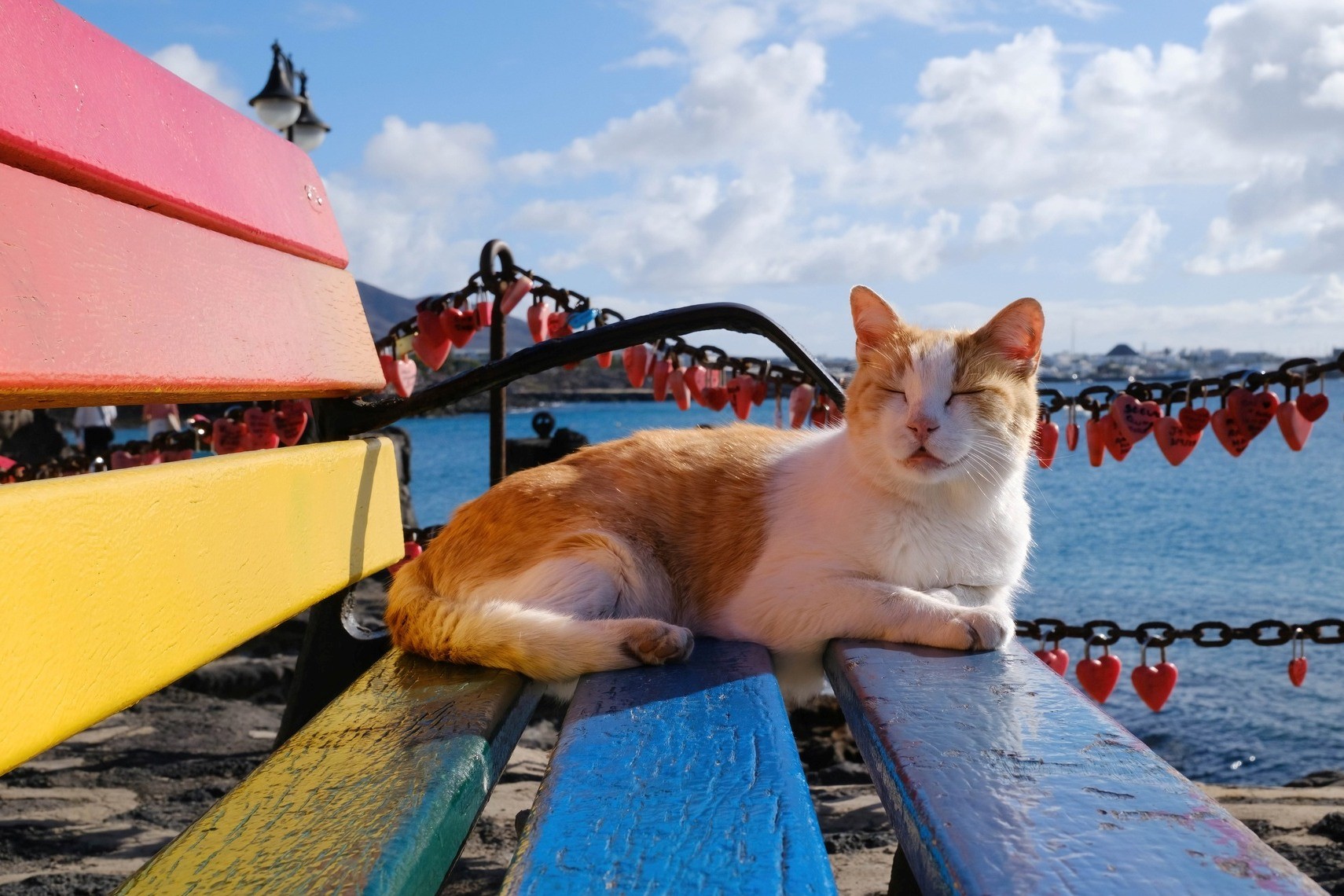
This adorable promenade cat in Lanzarote was a really good reason to take an early morning walk.
Economy: Where your money goes
The pressure of overtourism is also driven by economic imbalance. Independent cafés, bakeries, and family-run restaurants tend to anchor local areas rather than disrupt them.
There is a common observation in economic development that money spent at independent businesses stays in the local economy up to 3.5 times longer than money spent at global chains. While a global brand extracts profit for shareholders, a local trattoria or bakery anchors the neighbourhood’s social and financial routine.
Another upside? You’ll usually eat better, too – which is not an insignificant side benefit.
Manners are free. Respect the process.
Timed entry systems, visitor caps, and tourist taxes can feel inconvenient, but they exist for a reason. They are not anti-visitor; they are attempts to keep places working. And though we think of them as modern nuisances, they certainly aren’t new.
Venice has managed its visitor overload for centuries. Even in the 18th century, during the Grand Tour, the city struggled to balance its lived-in reality with its status as a cultural prop. They were masters of intentional limits – regulating everything from gondola aesthetics to visitor density – to ensure the city wasn’t overwhelemed.
Paying a visitor levy today is simply a modern iteration of that old professional respect for a destination’s endurance. Accepting these limits – booking ahead or skipping an attraction because access is restricted – is a small price to pay for ensuring these places endure.
Travel thoughtfully, not timidly
I want people to keep travelling, but I want them to do it with more awareness. Approaching destinations differently has started to show up for me in small ways: I look at shoulder season options first, I build in time to wander, and I pay more attention to where my money goes.
Part of any trip should be doing what we can to ensure that long after we’ve left, these places remain vibrant for the next visitor and liveable for the people who actually call them home. Travel with curiosity. Travel with intention. That’s how you become part of the solution – and end up with a better trip in the process.