It’s not the robot – it’s the operator

The lack of transparency and understanding around AI isn’t just annoying – it has consequences. For those using it and those reading what has been produced by it.

TLDR: A piece appeared in the New York Times with a quote attributed to Pierre Poilievre. The quote was made up by AI, no one bothered to check the quote. The piece ran and now the New York Times has published a correction saying ‘oops – the reporter should have checked’ and I think that’s a bit weak.

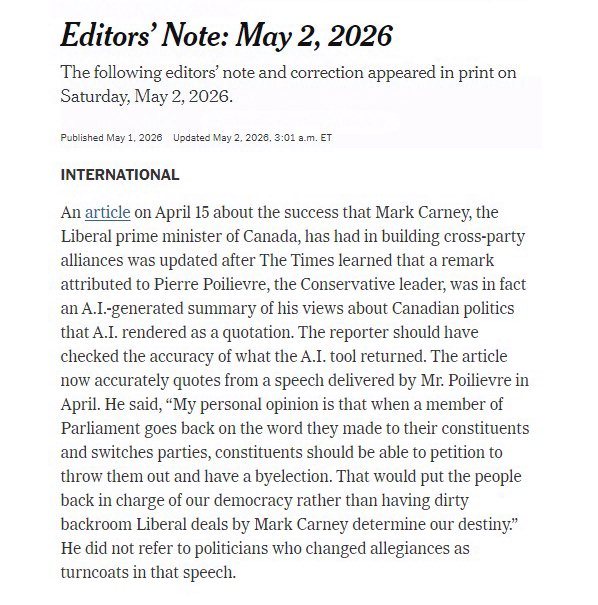
NYTimes Correction, May 2, 2026:  

"An article on April 15 about the success that Mark Carney, the Liberal prime minister of Canada, has had in building cross-party alliances was updated after The Times learned that a remark attributed to Pierre Poilievre, the Conservative leader, was in fact an A.I.-generated summary of his views about Canadian politics that A.I. rendered as a quotation. The reporter should have checked the accuracy of what the A.I. tool returned. The article now accurately quotes from a speech delivered by Mr. Poilievre in April. He said, “My personal opinion is that when a member of Parliament goes back on the word they made to their constituents and switches parties, constituents should be able to petition to throw them out and have a byelection. That would put the people back in charge of our democracy rather than having dirty backroom Liberal deals by Mark Carney determine our destiny.” He did not refer to politicians who changed allegiances as turncoats in that speech."


The NYT correction states says “the reporter should have checked the accuracy of what the A.I. tool returned” – which I suppose is their way of painting the incident as a simple verification lapse – but IMO that underplays what happened. There’s a HUGE difference between (a) using AI to summarise background info or using it to help structure notes and (b) allowing it to attribute quote. Quotes aren’t just details or info. They are evidence. If the reporter didn’t check, the problem isn’t AI. The problem is that the reporter outsourced attribution, a foundational part of their job – the part of the job on which public trust is built – to a tool that hallucinates. The second problem is that the reporter didn’t bother to check. The third problem is that the editorial workflow had room for the previous two problems to go un remarked until after publication.

That is all down to people. Not the tool

Of course, when it comes to light, the NYT is momentarily embarrassed but the ripple effect lives on – it erodes the public trust in what for decades was a paper of record. I should probably say ‘erodes even further’ given the decline in quality at the NYT from its once lofty perch of excellence. It also hands every bad-faith actor a glaring, very public, high profile citation for “even the NYT uses AI to make up quotes.”

We all know that an article, when published, will reach exponentially more people than the correction. In this case, it is entirely possible that the correction will become the story and that story will have a far longer tail than the original piece. Not because the robot got it wrong but because the people, the editorial guardrails and the workflow that one might expect to be in place at such an organisation failed – and they seem to have shrugged it off. Maybe a review of their ‘Principles for Using Generative A․I․ in The Times’s Newsroom’ page is in order.

5 Tips on Staying Visible in AI-Driven Search

Businesses of all sizes and in all sectors are increasingly worried about remaining visible in the AI-driven search world we now find ourselves in. Among the most concerned may well be the micro, small and medium size businesses (SMEs) who count on search and digital visibility to allow them to ‘punch above their weight’ and remain competitive.

The vast majority of businesses in the world are SME entities – and the people running those businesses are probably wearing a lot of operational hats, are frequently pressed for time and, though they may updating their own website, most of these people aren’t necessarily technical people or digital marketing people. So, it’s entirely probably that businesses like that might want a quick checklist for of things they can action immediately and without too much heavy lifting to improve their AI visibility.

This post is for them – the people with too much to do, not enough time to do everything they want and who still need to make sure their customers (current and potential) can find them online.

The difference between what search was and what it is becoming?

AI tools like ChatGPT, and AI summaries at the top of search results such as Google’s “AI Overviews”, are changing how people find travel information and ideas. Think of the difference this way:

  • SEO (search engine optimisation) is – was? – about getting a user to click your link on a results page
  • AIO (AI optimisation) is about getting the AI to cite your information directly in its answer/summary.

5 Tips on staying visible

1. Help People Find You in Natural Language

  • Write content the way your customers ask questions (“What can families do here on a rainy day?”). Avoid keyword stuffing — write naturally and clearly.
  • Use headers and subheaders (H1, H2, etc.) along with short paragraphs so information is easy to scan.
  • Add an FAQ section that answers common visitor questions clearly.

2. Keep Information Clear, Factual, Current and – if locality is part of your USP – Specific

  • Check opening hours, prices, contact details, and accessibility info regularly. Add location details (“5 minutes from the station”, “on the coastal path”) to support “near me” searches.
  • Include your local story or expertise (“Family-run cafe using local produce”)
  • Use up-to-date photos, menus, and activity lists.

3. Strengthen Trust and Credibility E-E-A-T (Experience, Expertise, Authoritativeness, Trust)

  • AI models are trained to prioritize information that is trustworthy and authoritative. For an SME, this means proving you are a real, credible expert in your niche.
  • Add an ‘About Us’ page showing who you are, your business’s history, mission, the people behind the brand.
  • Encourage genuine reviews on Google, Tripadvisor, etc. Actively collect and display genuine customer reviews and testimonials.
  • Link to partnerships or certifications

4. Make Your Website Easy for Search Engines and AI to Read

  • Structure your content for easy quoting and clipping – AI tools are looking for clear, concise information they can extract to build their answers. Make your content easy to “quote.”
  • Include descriptive image alt text (“View of our garden café”) for accessibility and clarity.
  • Remember what I said about an FAQ and natural language? That is also a big part of quote-ability.
  • Use Lists and Tables: AIs love a bit of structured data. Use bulleted lists for features, numbered lists for steps, and tables for comparisons to competition or different price packages
  • Long page? Start with “key takeaways” a box that summarizes the main points.

5. Keep Your Listings Consistent Across Channels

  • Update your Google Business Profile with correct hours, categories, and images. Yes, yes there are other search engines – but the business reality is that the vast majority of searches are happening on Google.
  • Use the same descriptions and keywords on your website, social media, and travel platform listings. Consistency is key.
  • Review content twice a year to keep it fresh and accurate.

Summary: A lot of good SEO in the AI era is simply a matter of good digital housekeeping: clear, consistent, trustworthy, and human-centred information. The difference with AI is that it is not enough to ‘show up’ – you need to show up as a strong, well-defined entity that AI can quote in a summary answer to a question.

Prompting – there’s a right way and a wrong way.

Listen, people can argue and post all they want about the dangers and/or benefits of AI. But whether you use it or not is up to you.

So, yes you can use AI tools if you want but please, PLEASE recognise that you will get out just what you put in. Prompt it in a slapdash way – you’re gonna get slapdash results. And even if you give it the most detailed prompt ever – you still need to check what it throws up in response.

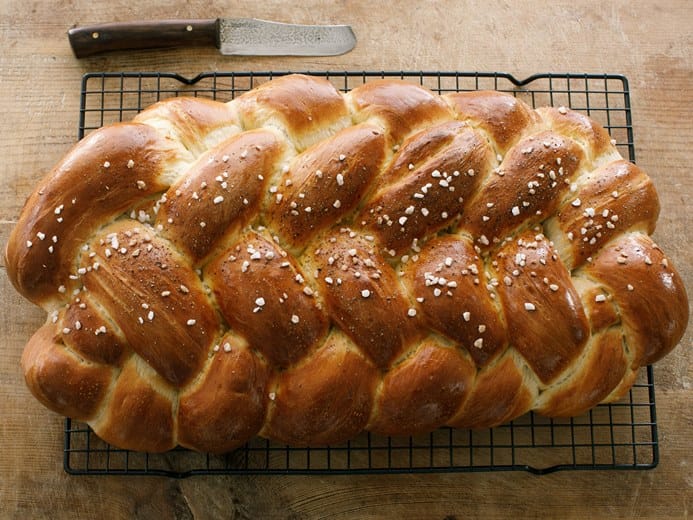
Don’t just tell it to write an essay on… oh I don’t know … challah. “Write an essay on challah” is pretty vague. And you’ll get vague results.

a braided bread, also called challah, with sesame seeds on top.

Give it details:

👨‍🍳 what role you want it to assume: food writer, baker, culinary or social historian, etc.

✍ what the project is: is the essay part of the larger project? Are there existing sections to use as guides? Is the essay for a food website or a social history journal?

👨‍👩‍👦‍👦 who the audience: general educated adult reader, bakers, a local food magazine, kids?

📏 how long should it be: 300 words or 1500 words?

📣 what tone or style: is this a formal report or an informal piece?

➕ / ➖ what to include or not: different shapes, recent trends or historical references? Regional differences or focus on a specific region?

✔ Check and challenge the results.

* * * * * * * * * * * * * * * * *
And then, use it as a jump off point for your own input. If you leave it as is – trust me, people can tell.